
How Do You Hang Christmas Lights Safely?
To hang Christmas lights safely, always inspect cords and bulbs for damage before use, use a sturdy ladder on stable ground with a spotter, never work on icy or snow-covered surfaces, use only outdoor-rated lights and extension cords outside, connect strings to a GFCI-protected outlet, keep connections dry and off the ground, and turn lights off before going to bed or leaving the house. When working at height or on complex rooflines, professional installation is the safest option.
The holiday season brings long, dark evenings and the warm glow of lights strung across homes and properties across Oakville and south Mississauga. It also brings emergency room visits that didn’t need to happen.
Every year, thousands of Canadians are injured during holiday decorating — falls from ladders, electrical shocks, and fires caused by faulty lights or overloaded circuits. These aren’t freak accidents. They’re almost always the result of rushing, cutting corners, or underestimating the risks involved in working at height with electrical equipment in cold and often icy conditions.
This guide covers every safety consideration for holiday lighting installation — from inspecting your lights before you start, to ladder safety on winter surfaces, to electrical hazards most homeowners don’t think about. If you read it and decide the job is more than you want to take on safely, our professional installation team is ready to handle it for you.
Step 1: Inspect Your Lights Before You Do Anything Else
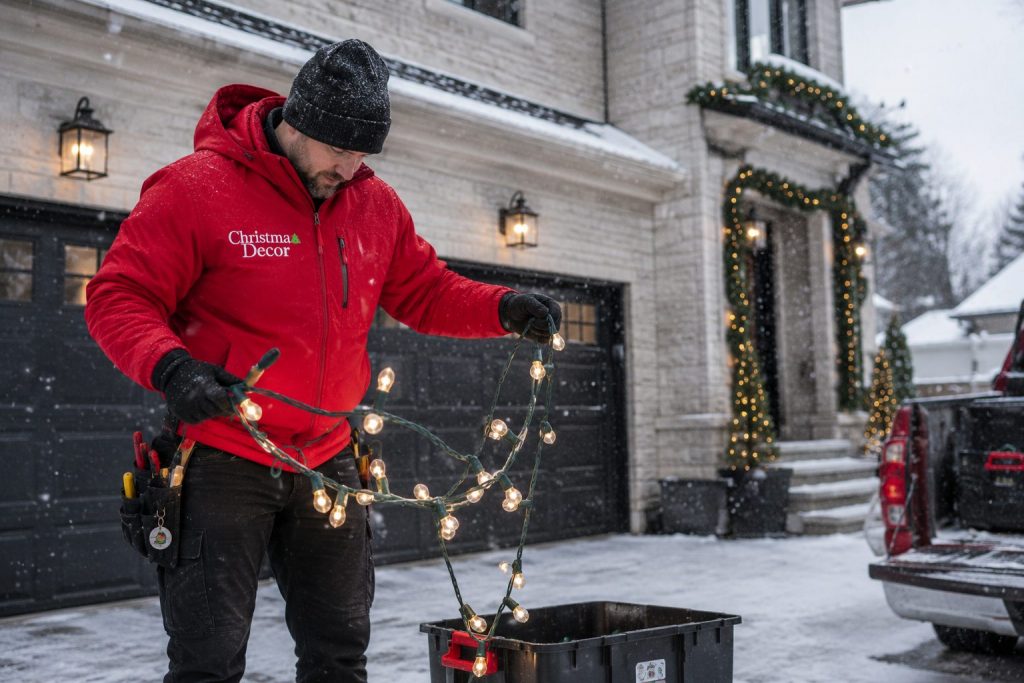 The most common — and most avoidable — hazard in holiday lighting is damaged equipment. Lights stored in a garage or basement over summer can develop cracked insulation, corroded contacts, and loose connections that aren’t visible until something goes wrong.
Before hanging a single strand, inspect every string of lights for:
- Frayed, cracked, or bare wires — discard immediately, do not attempt to repair with tape
- Broken, cracked, or missing bulbs — broken glass is a cutting hazard and an exposed socket is a fire risk
- Loose or damaged plugs and connectors — a loose connection can arc and cause a fire
- Burn marks or melted plastic anywhere on the string — a sign of previous overheating; retire the string
- Corrosion on metal contacts — this increases resistance, generates heat, and raises fire risk
When in doubt, throw it out. A replacement string of LED lights costs a few dollars. An electrical fire costs far more — in every sense of the word.
Always use lights rated for outdoor use when decorating outside. Indoor lights are not weatherproofed and are not designed to handle moisture, temperature swings, or the direct exposure of an Ontario winter. The packaging will clearly state whether lights are rated for indoor use only or for both indoor and outdoor use. Do not substitute.
Electrical Safety: What Most Homeowners Get Wrong
Don’t Overload Your Circuits
One of the most common causes of holiday electrical fires is overloaded circuits. Most residential outlets are protected by a 15-amp circuit breaker. Exceeding that capacity — by plugging in too many strings, too many extension cords, or too many devices on the same circuit — generates heat in the wiring and can cause a fire inside your walls.
Key electrical rules for holiday lighting:
- Check manufacturer guidelines on how many strings can be safely connected end-to-end. For incandescent lights, the maximum is typically 3 strings; LED strings can usually be connected in runs of 40 or more
- Never use indoor extension cords outdoors — they are not weatherproofed and pose a serious shock and fire risk
- Use heavy-gauge outdoor-rated extension cords sized for the load you’re placing on them
- Plug outdoor lights into a GFCI (Ground Fault Circuit Interrupter) outlet — these cut power instantly if the circuit detects a ground fault, preventing electrocution. Most outdoor outlets installed in Canadian homes since the 1990s are GFCI-protected; if yours aren’t, a GFCI adapter plugs into any standard outlet
- Keep all plug connections and extension cord joints off the ground and away from standing water, snow, and ice — moisture and electricity are a dangerous combination
- Never run extension cords under rugs, mats, or through doorways where they can be pinched or damaged
Turn Lights Off When You’re Not Home and Before Bed
Leaving holiday lights on unattended overnight or when the house is empty is one of the most preventable fire risks of the season. Use a programmable timer — which costs very little and is available at any hardware store — to automatically turn lights on at dusk and off at a set time in the evening. This not only reduces fire risk but also saves electricity.
Never use outdoor lights indoors or indoor lights outdoors. The two are not interchangeable, and using them incorrectly creates both fire and shock hazards. This includes extension cords — always match the rating to the environment.
Switch to LED if You Haven’t Already
LED Christmas lights are significantly safer than traditional incandescent bulbs. They run much cooler — reducing fire risk from overheating — and they’re made from durable plastic rather than glass, making broken bulb situations far less hazardous. They’re also far more energy-efficient, which means you can run longer strings on the same circuit without overloading it.
All Christmas Décor installations use commercial-grade LED lighting that is specifically rated for outdoor use in Canadian winter conditions — brighter, more durable, and safer than anything available in retail stores.
Ladder Safety: The Biggest Risk of the Season
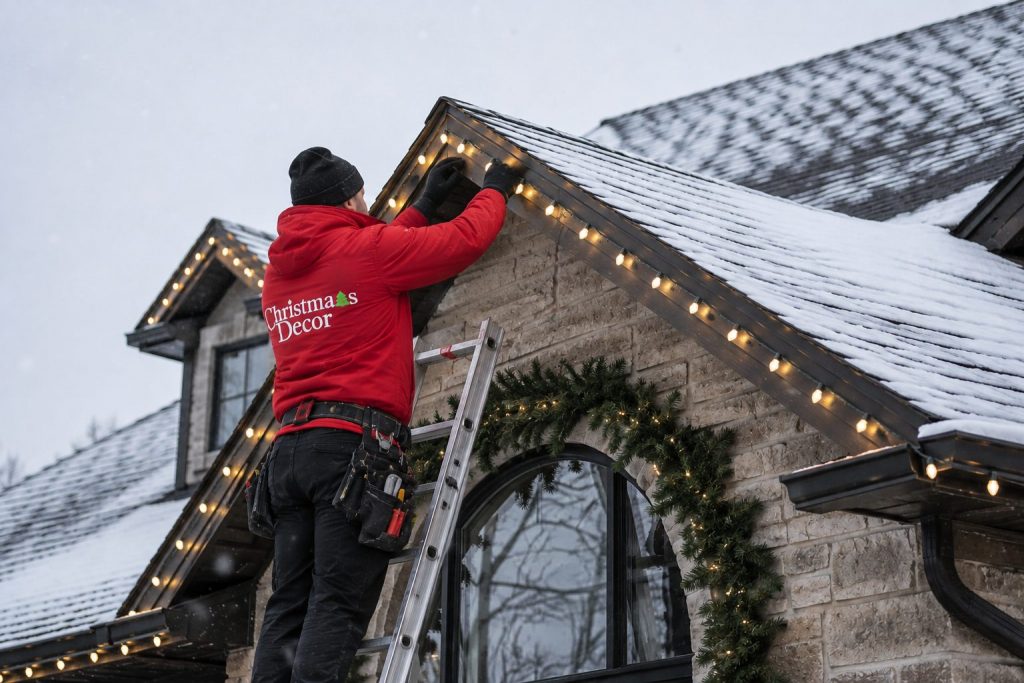 Falls from ladders are the leading cause of serious holiday decorating injuries in Canada. November is statistically the peak month for ladder-related emergency room visits — not a coincidence given that it’s the primary month for putting up outdoor lights. Cold temperatures, icy surfaces, and the distraction of working with lights while balanced on a ladder create a genuinely dangerous combination.
If you’re going to use a ladder, follow these rules without exception:
- Inspect the ladder before use — check for cracks, bent rungs, or loose fittings; never use a damaged ladder
- Set the ladder on firm, level ground — never on ice, snow, or soft ground that could shift
- Check the roof or surface you’re leaning the ladder against for ice before you climb — a ladder that seems stable on the ground can shift if the surface it’s leaning against gives way
- Use the correct ladder for the job — a ladder that’s too short forces you to overreach, which is one of the most common causes of falls
- Always have a spotter — someone standing at the base of the ladder to stabilize it and assist if needed. Never work on a ladder alone
- Keep three points of contact on the ladder at all times — both feet and one hand, or both hands and one foot
- Never lean or overreach from a ladder — if you can’t reach something comfortably, come down and reposition the ladder
- Wear footwear with good grip — avoid smooth-soled shoes, boots without tread, or anything that could slip on a rung
- Do not carry heavy loads up a ladder — use a tool belt or have your spotter pass materials up to you
Rooftop and second-storey work is the highest-risk category. Getting onto a roof in November or December — when surfaces may be frost-covered even when they don’t look icy — is genuinely dangerous without proper equipment and training. Our professional installers are specifically trained for working at height and carry full liability insurance. If your lighting design involves the roofline or upper storey of your home, professional installation is the safest choice.
Outdoor-Specific Safety Considerations
Keep Connections Dry
All outdoor plug connections and extension cord joints should be kept off the ground and protected from moisture. Use a weatherproof connection cover — available at any hardware store — to protect outdoor plug connections from rain, snow, and ice. Even lights rated for outdoor use are designed to withstand weather on the cord and bulbs, not at the connection points, which remain a vulnerability.
Secure Cords Away from Foot Traffic
Extension cords running across driveways, walkways, or areas where people will be walking are both a tripping hazard and a damage risk. Cords that are repeatedly driven over or walked on develop insulation damage that isn’t visible until the wire shorts out. Route cords along the base of the house, under eaves, or through protected channels — and clearly mark any cord that crosses a walkway with a bright cover or tape.
Use Proper Clips, Not Staples or Nails
Never use metal staples or nails to fasten light strings to your home or eaves. Staples and nails can pierce the wire insulation, creating a live electrical short hidden inside your wall or eave that can cause a fire. Use plastic light clips specifically designed for hanging Christmas lights — they hold securely without damaging the cord and can be reused season after season.
Protect Against the Elements
Ontario winters bring freeze-thaw cycles, ice storms, and heavy snow loads. Make sure any lights you hang are rated to handle these conditions. Commercial-grade outdoor LED lights — like those used by Christmas Décor — are specifically engineered for Canadian winters. Consumer-grade lights, particularly older incandescent strings, may not hold up to sustained cold, repeated freezing and thawing, or heavy snow accumulation.
Safe Storage When the Season is Over
Improper storage is responsible for a significant number of damaged lights that create hazards the following season. After the season ends:
- Allow lights to dry completely before packing them away — moisture trapped in stored lights accelerates corrosion
- Wrap strings around a purpose-made cord reel or a piece of cardboard cut to size — this prevents the tangling and cord stress that leads to insulation damage
- Store lights in a sealed container in a location that doesn’t experience extreme temperature swings — a heated garage or basement is better than an unheated shed
- Label your strings by length and colour so you don’t have to untangle everything to find what you’re looking for next season
- Discard any string that you’re not confident about — a string that was marginal this season will be a problem next season
Of course, if you hire Christmas Décor, you don’t deal with storage at all. We take everything with us at the end of the season and return it the following year in perfect condition. No boxes, no tangles, no damaged lights.
When to Call the Professionals
The safety considerations in this guide are real — and for many homeowners, working through all of them while also planning and executing a holiday lighting display is more than they want to take on. That’s not a failure of ambition. It’s a reasonable assessment of risk.
Christmas Décor of Oakville has been professionally installing holiday lighting for homes and businesses in Oakville and south Mississauga since 1998. Our team is trained, insured, and equipped for safe work at height. We use commercial-grade outdoor-rated LED lighting on every installation. And we handle everything — design, installation, maintenance, and removal — so you never need to climb a ladder. Request a free quote and let us take the risk entirely off your plate.
Let Christmas Décor Handle It Safely
Book your free design consultation today. Call us at 905-632-2445 or request a quote online. We serve Oakville and south Mississauga (south of the QEW) and we’d love to give you a beautiful, safe holiday display — with zero ladders required on your part.