
How Do You Light Outdoor Trees for Christmas?
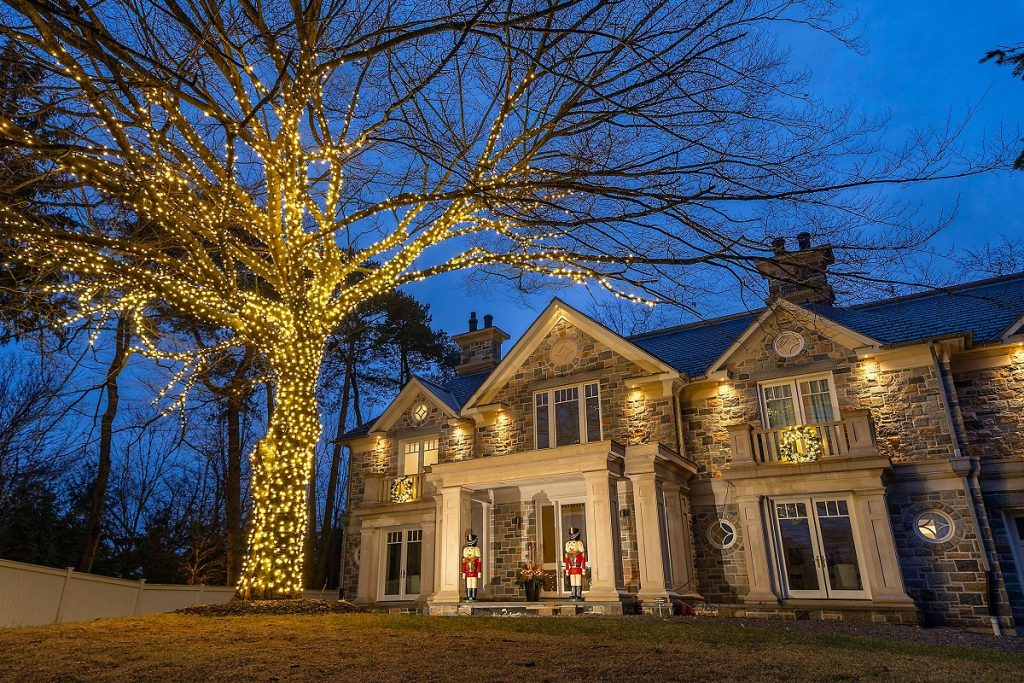
Outdoor Christmas trees can be lit using three main techniques: horizontal wrapping (lights wound around the outer shape of the tree), vertical wrapping (strands dropped from the top to create a maypole or cascading effect), and trunk and branch wrapping (lights wound tightly around the trunk and individual branches for a dramatic bare-tree effect). The right technique depends on your tree type — evergreen or deciduous — its size, and the visual result you want. Professional installers can also create a canopy wrap effect by lighting the entire crown of the tree for a spectacular overhead display.
Your trees are some of the most dramatic features of your property — and during the holiday season, they’re also some of the most underused. A beautifully lit outdoor tree transforms a yard from nicely decorated to genuinely breathtaking. The warm glow of wrapped branches against a dark winter sky, or a perfectly shaped evergreen silhouetted in lights, is the kind of display that stops people in their tracks.
Christmas Décor of Oakville has been professionally lighting the trees of homes and businesses in Oakville and south Mississauga since 1998. We’ve wrapped thousands of trees — evergreens, maples, oaks, ornamentals, hedges, and everything in between. This guide pulls together everything we’ve learned about outdoor tree lighting, from choosing the right technique for your tree type to planning your light count and creating a display that complements your whole property. If you’d rather just have it done for you, our tree décor service handles everything from design through installation, maintenance, and removal.
Why Trees Are the Centrepiece of Your Holiday Lighting Display
When we design holiday lighting displays for homes and businesses in Oakville and south Mississauga, trees are almost always the first element we plan around. Here’s why:
Trees add vertical dimension to an outdoor display. Roofline lighting, garland, and wreaths are all horizontal — they follow the flat plane of the house. Trees break that up, drawing the eye upward and creating a sense of depth and drama that a house alone can’t achieve.
Trees also soften the display. A home outlined in lights can look striking but rigid. Lit trees — especially deciduous trees with their irregular branching patterns — add an organic, warm quality that makes the whole display feel more magical and less architectural.
And practically speaking, trees extend your display into the yard, creating a sense that the lighting is part of the entire property rather than just something applied to the front of the house. A well-lit yard with illuminated trees feels like an experience rather than a decoration.
Step 1: Assess Your Trees Before You Plan
Before selecting a lighting technique, take time to properly assess the trees on your property. Walk to the street and look back at your home from the perspective of someone passing by. Note which trees are most visible, which frame the house naturally, and which might be better left unlit to avoid a cluttered look. The goal is to enhance what’s already beautiful about your property — not to light every tree just because it’s there. Browse our photo gallery for inspiration on how trees can anchor a complete holiday lighting design.
Key things to assess:
- Tree type — evergreen (conifer) or deciduous (bare in winter)
- Height and canopy spread — determines light count and technique feasibility
- Proximity to the house — trees close to the home can tie the display together; isolated trees need to hold their own
- Existing features — interesting bark, dramatic branching, or strong silhouette shapes all influence technique selection
- Colour and style of your overall display — your trees should complement your roofline, windows, and entrance lighting
Match the colours and intensity of your tree lighting to the rest of your display. A house outlined in warm white with multi-colour trees rarely reads as intentional. Consistency creates a design that looks professional rather than assembled one string at a time.
The 4 Main Outdoor Christmas Tree Lighting Techniques
Technique 1: Horizontal Wrapping
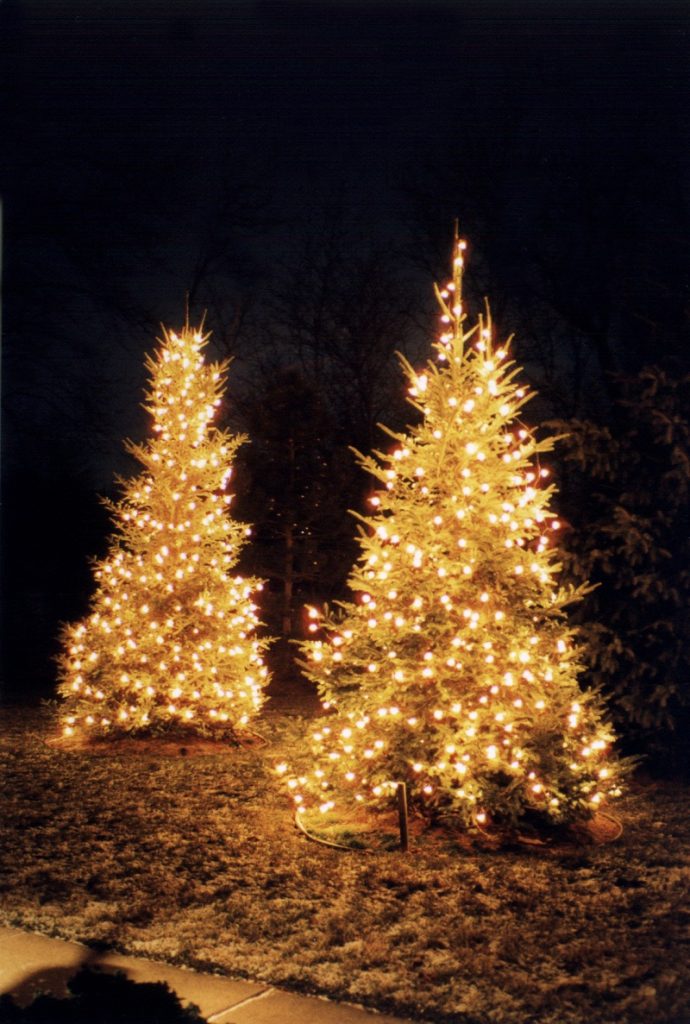
Horizontal wrapping is the most widely used technique for both evergreen and deciduous trees. Starting at the base of the tree, lights are wound around the outermost edge of the tree’s silhouette in horizontal bands all the way up — or as high as you want to go.
The result is a rounded, full appearance that reads beautifully at night. The shape of the tree becomes luminous, glowing from within its own canopy rather than being outlined from the outside.
Tips for horizontal wrapping:
- Use larger bulbs (C7 or wide-angle LED) on evergreens to push light through dense foliage
- Mini lights work well on deciduous trees and create a more delicate, sparkling effect
- You don’t need to wrap all the way to the top — at night, the eye doesn’t see where the lights stop, so a partial wrap can create a lovely floating effect in the upper canopy
- For a more defined shape, use moderate to heavy light density; for a softer effect, use lighter coverage
- Our professional team can wrap trees right to the very top safely — something that’s difficult and dangerous to achieve on a ladder at home
This technique is available through our canopy wrap service — ideal for large evergreens and ornamental trees where full coverage creates the most dramatic effect.
Technique 2: Vertical Wrapping (The Maypole Effect)
Vertical wrapping anchors strings of lights at or near the top of the tree, then allows them to fall vertically to the ground in evenly spaced strands around the circumference of the tree. The result resembles a maypole or a cascade of light flowing from the crown downward.
This technique works best on evergreen trees that taper from a wide base to a narrower top, because the vertical strands naturally follow the tree’s conical shape and create that classic Christmas tree silhouette. It reads beautifully from a distance and has a dramatic, formal quality.
Tips for vertical wrapping:
- Space vertical strands evenly around the tree for a clean, symmetrical look
- The more strands used, the more defined the shape; fewer strands creates a more open, floaty effect
- This technique is height-dependent — getting strands anchored safely at the top of a large tree requires proper equipment
- Works best with mini lights or 5mm wide-angle LED bulbs for a fine, delicate curtain of light
Technique 3: Trunk and Branch Wrapping
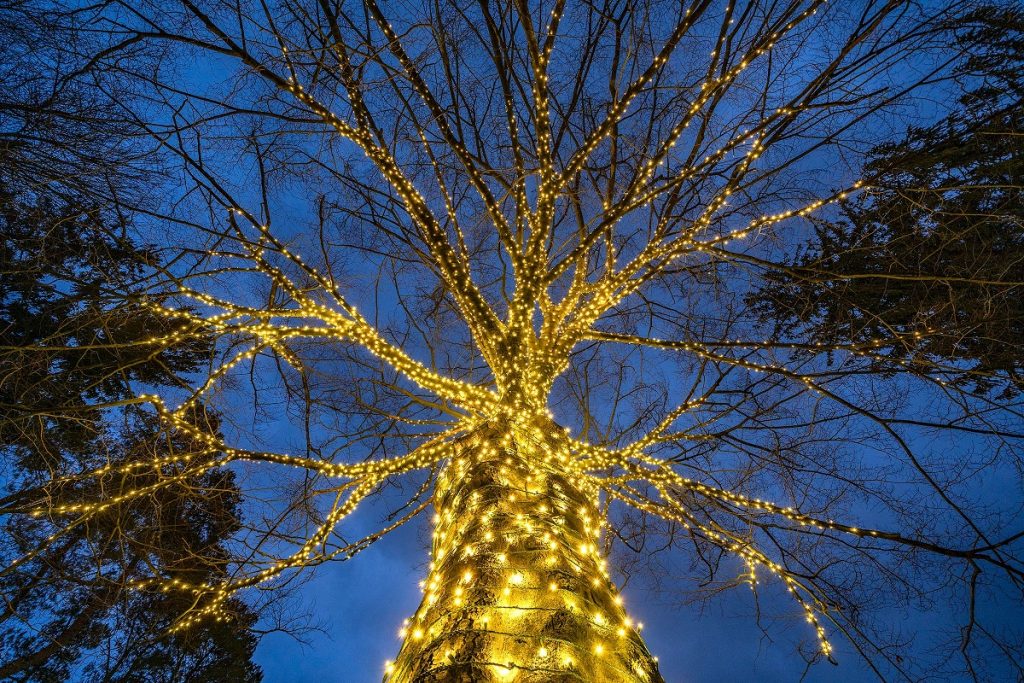
Trunk and branch wrapping has become one of the most popular and striking tree lighting techniques, particularly for deciduous trees in winter. Without their leaves, the bare branching structure of trees like maples, oaks, and ornamentals becomes a dramatic sculptural element — and wrapping those branches in light turns each tree into a work of art.
Unlike horizontal or vertical wrapping, which light the outer shape of the tree, trunk and branch wrapping follows the actual structure of the tree — trunk, main scaffold branches, and secondary branches. The result is something much more three-dimensional and architectural.
Christmas Décor offers trunk and branch wrapping at three different intensity levels:
- Light: Trunk and primary branches only — elegant and understated, ideal for smaller trees or as a complement to house lighting
- Medium: Trunk, primary, and secondary branches — a fuller, richer look that gives the tree genuine presence
- Heavy: Full branch coverage including tertiary branches — a spectacular, completely luminous tree that becomes the focal point of the entire display
Tips for trunk and branch wrapping:
- Decide in advance how high you’ll wrap each branch and keep that stopping point consistent across all branches — inconsistent heights are obvious even at night and undermine the finished look
- Use mini lights or fairy lights for a delicate, detailed effect; use larger bulbs for more visual impact from the street
- This technique uses a lot of lights — budgeting for the right light count before you start saves frustration mid-project
- On tall or complex trees, professional installation is strongly recommended — working at height while wrapping branches requires the right equipment and experience
See examples of our trunk and branch installations in the Christmas Décor gallery, and learn more about our trunk and branch wrapping service.
Technique 4: Canopy Lighting
Canopy lighting is the most dramatic of the four techniques — and the most spectacular when done well. Rather than wrapping the trunk or outlining the shape, canopy lighting illuminates the entire crown of the tree from within, filling the upper canopy with light so the tree glows like a lantern against the dark sky.
This technique works best on mature trees with broad canopies — large maples, oaks, or similar. When the canopy is fully lit from within, the effect is extraordinary: the entire yard beneath is bathed in a warm, ambient glow, and the illuminated crown becomes a focal point visible from well down the street.
Canopy lighting requires significant light counts, proper rigging to place lights safely throughout the upper crown, and usually commercial-grade equipment. It’s almost exclusively a professional installation — and the results reflect that.
Ask about our canopy wrap service when requesting your free design consultation.
Tree Type Matters: Evergreen vs. Deciduous vs. Shrubs
Evergreen Trees (Spruce, Pine, Cedar, Juniper)
Evergreen trees are dense — their foliage is thick year-round, which means light needs to penetrate that mass to create the right effect. For horizontal wrapping, use string lights with 6″ bulb spacing rather than the standard 4″ to push light further into the canopy. Wide-angle LED bulbs also distribute light more effectively through dense foliage than mini lights.
For light count planning, a medium effect on an evergreen requires approximately 100 mini lights per vertical foot. For a heavier, more dramatic effect, budget roughly 200 mini lights per vertical foot. These are starting estimates — the width and density of your specific tree will influence the final count.
Deciduous Trees (Maple, Oak, Ash, Ornamentals)
Deciduous trees in winter offer an entirely different opportunity. Without leaves, the branching architecture becomes the display — and trunk and branch wrapping is almost always the most effective technique. Because there’s no foliage to light through, deciduous trees generally require fewer lights than evergreens of similar height, and the detail of the wrapping shows clearly.
For a simple but impactful look on a deciduous tree, draping lights over the main branches and wrapping the trunk creates a beautifully textured glow. For a more elaborate effect, full trunk and branch wrapping at medium or heavy intensity creates something truly show-stopping.
Shrubs, Hedges, and Bushes
Shorter plantings deserve attention too. Net lights are ideal for hedges and rounded shrubs — they’re quick to apply, provide even coverage, and remove easily. The key when using net lights is to stretch them out properly so the pattern reads as a soft glow rather than a visible grid.
For shrubs with interesting branching structure, wrapping individual branches with mini lights creates a more detailed, organic look. Pathway shrubs lit from within also provide practical safety lighting — guiding guests from the street to the door without the solar stake lights that struggle in Canadian winters.
How Many Lights Do You Actually Need?
One of the most common DIY tree lighting mistakes is underestimating how many lights are needed. A tree that looks adequately lit to you while standing next to it often looks sparse and underwhelming from the street — which is the perspective that matters most for outdoor holiday lighting.
General planning estimates from our Christmas Décor team:
- Medium effect: approximately 100 mini lights per vertical foot of tree height
- Heavy effect: approximately 200 mini lights per vertical foot
- These estimates apply to average-width trees — wide, dense evergreens may need more; slender ornamentals may need less
- Always buy or plan for more than you think you need — running out of lights mid-tree means a second trip to the store or a visibly unfinished result
When in doubt, go heavier than you think you need. A generously lit tree looks intentional and professional. A sparsely lit tree looks like you ran out of lights — because you probably did.
Design Tips for a Cohesive Tree Lighting Display
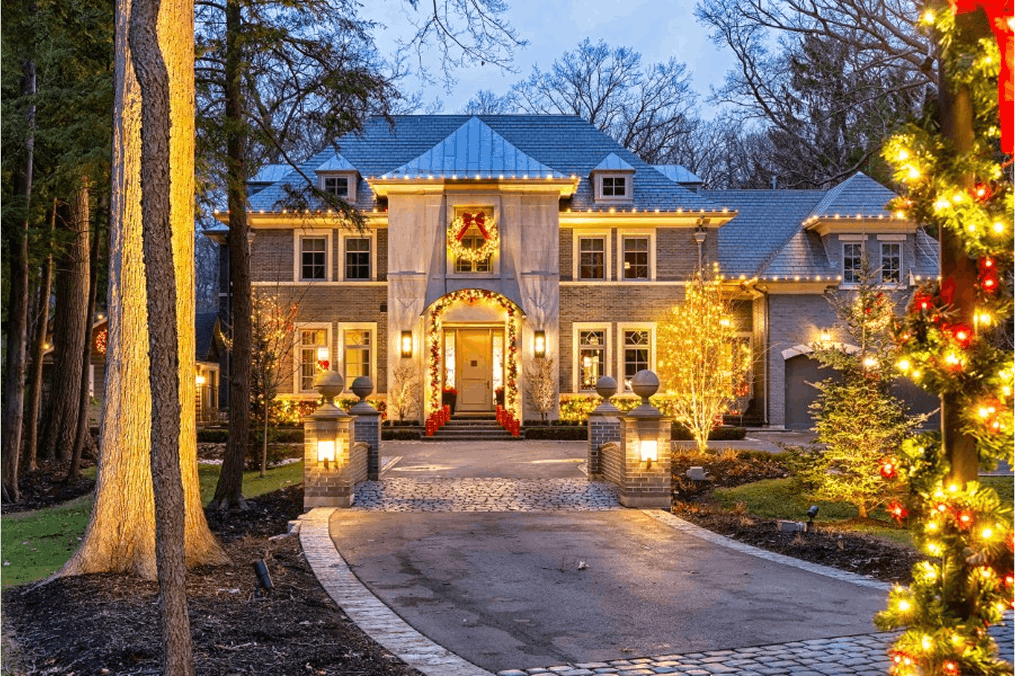
Match your tree lighting to your overall display. If your home is lit in warm white, your trees should also be warm white — or at minimum, a warm complementary colour. A cohesive colour palette across the entire property is the single biggest factor that separates a professional-looking display from a DIY one.
Think about balance. If you’re lighting trees on one side of the front yard, light them on both sides. Asymmetrical displays look unfinished. If you only have trees on one side, balance them with other elements — additional roofline lighting, a lit pathway, or a feature like a lit wreath — on the other.
Use trees to frame the house. Trees positioned at the corners of your front yard naturally frame the home and draw the eye inward. Lighting these anchor trees — even modestly — creates a composed, intentional scene rather than scattered decoration.
Think about what the display looks like from different distances. From the sidewalk, you’ll see the whole scene. From the street, you’ll see primarily the upper portions of lit trees and the roofline. Make sure there’s visual interest at every distance.
Consider having your lights turn on at dusk. The transition from daylight to full dark is actually the most magical window for outdoor lighting — the growing dusk amplifies the warmth of the lights in a way that’s different from full dark. A timer set to turn on slightly before sunset captures that glow at its best.
Use pathway trees for safety lighting. Trees or shrubs along walkways and driveways that are lit with wrapped or net lights provide warm, inviting safety lighting for guests arriving after dark — far more attractive than post lights or solar stakes, which struggle in Ontario winters.
Why Let Christmas Décor of Oakville Light Your Trees?
Tree lighting is the element of holiday decorating most homeowners underestimate. It’s not just a matter of having enough lights — it’s about choosing the right technique for the right tree, planning the light count accurately, working safely at height, and creating a display that integrates seamlessly with everything else on the property. That’s what our team does every day of the season.
Here’s what our tree lighting service includes:
- Free design consultation — we assess your property and recommend the right technique and intensity for each tree
- Professional installation by an experienced, insured team — we safely reach heights that homeowners can’t
- Commercial-grade LED lighting — brighter, more efficient, and built for Canadian winters
- Proactive maintenance — if a strand goes dark mid-season, we fix it
- Professional removal and storage at the end of the season — you do nothing
- Over 25 years of experience lighting homes and businesses in Oakville and south Mississauga
Whether you want one statement tree wrapped in your front yard or an entire property transformed with illuminated canopies, trunks, and cascading lights, Christmas Décor of Oakville delivers results that consistently exceed expectations. Visit our tree décor service page to learn more, or browse the gallery to see our work.
Ready to Light Up Your Trees This Holiday Season?
Book early — our installation calendar fills up quickly from September through November. The homeowners who call in September get the most flexibility on timing and often achieve the most thoughtfully planned displays.
Contact Christmas Décor of Oakville for your free, no-obligation design consultation. Call us at 905-632-2445 or request a quote online. We serve Oakville and south Mississauga (south of the QEW) and we’d love to make your trees the most beautiful thing on the street this December.